Compare › Comparison
Senshin vs Asana: which fits?
Asana is excellent at making sure everyone knows who is doing what by when. Senshin is for the follow-up question: so are we actually going to land it? We are the vendor of Senshin, so we will be careful to be fair.
At a glance
Quick view of Asana and Senshin side by side, so you can see in a minute whether this is a real choice or two different jobs.
- Built for: coordinating team work and tasks.
- Senshin is built for: one delivery record across plan, RAID, finance, people and governance.
- Strongest at: clarity on tasks, owners and deadlines for teams.
- Senshin is strongest at: governance, finance and what-if analysis for delivery.
- Typical user: teams and team leads.
- Senshin typical user: project managers, PMOs and sponsors.
What Asana is built for
Asana describes itself as a work management platform that helps teams plan, organise and track work. It is widely liked for being clear about who owns what and by when.
For team coordination that clarity is a real asset; for a steering committee you may want more structure around risk, cost and decisions.
- Organising tasks, projects and ownership so teams know who does what.
- List, board, timeline and calendar views of the same work.
- Collaboration features that keep conversation next to the task.
- Goal and portfolio features for linking work to wider aims.
Where Senshin fits
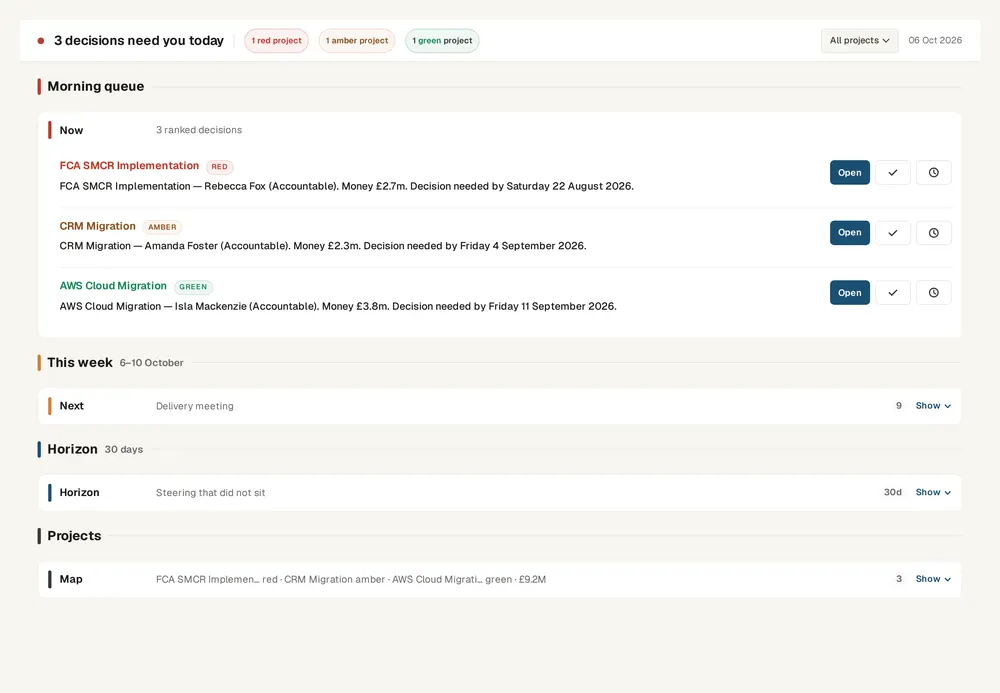
Senshin is a delivery intelligence platform that sits above your systems of record. It keeps one record for the plan, the RAID log, finance, people and governance, then produces reports and runs what-if scenarios from that single record.
The idea is simple: the system where work is done and the place where a delivery lead gets the honest picture do not have to be the same place.
- Plan, RAID, finance, people and governance connected in one record.
- Weekly and SteerCo reports drawn from that record.
- Control Tower for health across a portfolio.
- What-if simulations to test a change before agreeing it.
- Sensei to help explore and summarise.
When Asana is the better choice
If your need is a clean way for a team to track tasks and stay coordinated, Asana is an excellent fit and Senshin would be overkill. A lighter platform wins when the work is straightforward.
Senshin is aimed at those who must account for delivery, not simply organise it.
- Day-to-day team task management with low overhead.
- Cross-functional work where collaboration around tasks is the point.
- Teams that value simplicity and quick adoption.
- Linking everyday work to organisational goals.
Who should pick which
Pick Asana for team coordination. Pick Senshin when a sponsor wants the plan, the risks, the budget and the decisions to tell one consistent story.
- Team lead organising tasks: Asana.
- Project manager with a RAID log and budget to defend: Senshin.
- PMO seeking consistent steering committee reporting: Senshin.
- Larger set-ups: Asana for team work, Senshin above it.
Using them together
Use document ingestion to import an existing plan into Senshin, then keep delivering in Asana if that is where the team already works.
Senshin supplies the joined-up record and reporting above the day-to-day tasks.
- Import the current plan.
- Add RAID, finance and governance.
- Leave team tasks in Asana.
- Report to sponsors from Senshin.
See it on your own project
Fourteen days with the sample projects, or with your own plan, RAID log and budget. Then decide.
Start your 14-day trialWhere this lives in Senshin
Or £499.90 a year. Every plan starts with a 14-day trial; after it, your work stays, read-only, until you subscribe. Cancel any time. Prices exclude tax. Enterprise is priced per contract: talk to us.
Frequently asked questions
Is Senshin an Asana alternative?
For delivery governance and reporting, it can be. For everyday team task management Asana is the more natural fit. We are the vendor of Senshin, so this is not a neutral view.
Can I bring an Asana plan into Senshin?
Senshin offers document ingestion for importing an existing plan. Check that your export format is supported before relying on it.
Do small teams need Senshin?
Not always. A team that just wants to organise tasks may be well served by a lighter platform such as Asana.
Does this describe Asana fully?
No. We keep to broad statements based on what the product says about itself, and suggest you evaluate it directly.
More comparisons
Last updated: