Guides › Guide
What does a PMO do?
Ask five people what the PMO does and you will hear five answers, one of which involves the word police. Here is what a project management office is actually for, and how to stop it becoming the department that just sends reminders.
The short answer
A PMO, or project management office, exists to help the organisation deliver projects consistently. It sets the standards, supports the people running the work, and gives leadership one trustworthy view of what is going on across the portfolio.
Some PMOs do all of that. Some do one slice, typically reporting, and get tired of being asked for the rest.
- Standards: templates, methods and definitions such as RAG status.
- Support: coaching, training and help for project managers.
- Visibility: portfolio reporting that leaders can rely on.
- Governance: making sure the right decisions go to the right forum.
The three common models
PMOs tend to sit at one of three points on a dial from helpful to controlling. Knowing where yours sits explains most of the friction around it.
- Supportive: offers templates, advice and good practice, with little enforcement.
- Controlling: requires use of set methods and templates, and checks compliance.
- Directive: manages the projects itself and supplies the project managers.
Day-to-day functions
Look at a PMO calendar and the same activities keep turning up. None of them are glamorous; all of them matter when a sponsor asks for the truth at short notice.
- Collecting weekly status and turning it into portfolio reports.
- Running the intake process for new project requests.
- Maintaining the shared RAID log view and chasing overdue actions.
- Tracking benefits and budgets across projects.
- Running health checks on projects that look wobbly.
- Organising lessons learned and sharing them.
Signs a PMO is adding value
The test is simple: do project managers want to talk to it? A PMO that makes work lighter gets invited in. One that adds forms gets avoided.
- Project managers fill in one status update, not three.
- Leaders get early warnings, not surprises at the steering committee.
- Templates save time instead of costing it.
- Decisions are escalated quickly and answered quickly.
Where a platform helps
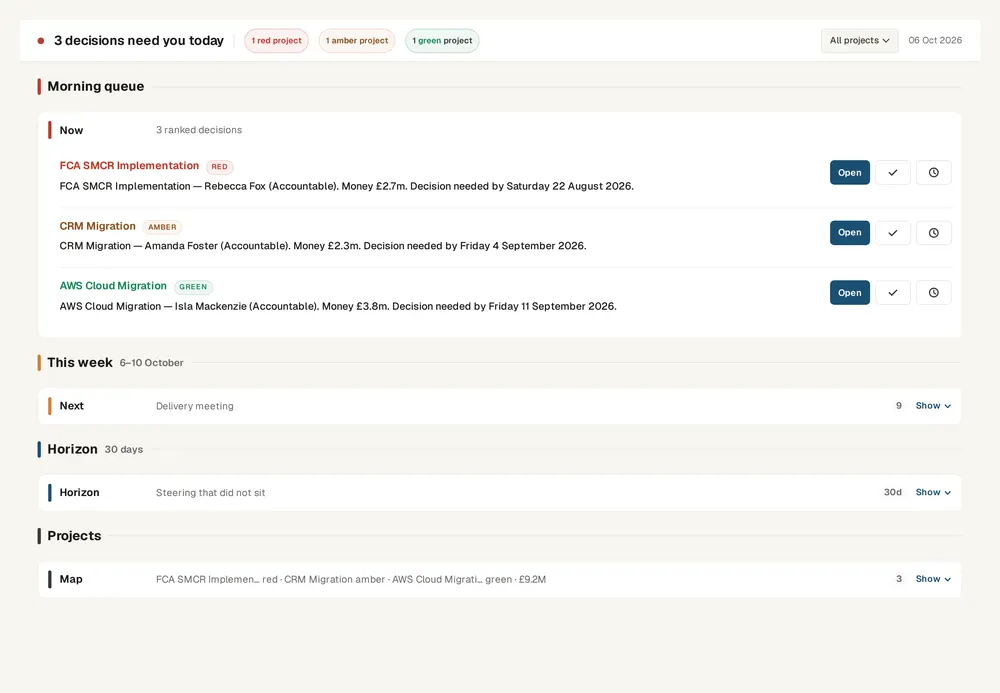
Much of PMO effort is gathering and reconciling numbers by hand. In Senshin the Control Tower shows portfolio health in one place, and weekly reports are drafted from the same data the project managers already maintain.
Keep this live, not in a spreadsheet
Senshin keeps your plan, RAID, budget and reports in one place, so this stays current without a weekly copy-and-paste. A 14-day trial, with sample projects.
Start your 14-day trialWhere this lives in Senshin
Or £499.90 a year. Every plan starts with a 14-day trial; after it, your work stays, read-only, until you subscribe. Cancel any time. Prices exclude tax. Enterprise is priced per contract: talk to us.
Frequently asked questions
What does a PMO do in simple terms?
A PMO sets project standards, supports project managers and reports on portfolio health, so leaders can see what is on track and what needs a decision.
What is the difference between a PMO and a project manager?
A project manager delivers one project. A PMO supports many projects at once, setting the standards and building the overall picture.
What are the types of PMO?
The usual three are supportive, controlling and directive, from advisory through to the PMO managing projects directly.
Do small companies need a PMO?
Not always a formal one. Even a single person who owns templates, reporting and portfolio visibility delivers much of the value.
More guides
Last updated: