Guides › Guide
Programme vs project
Call something a programme and it sounds grander, and the meetings multiply. Here is the real difference between a programme and a project, and when you actually need one.
The short answer
A project is a temporary effort to produce a defined output within agreed time, cost and scope. A programme is a group of related projects and activities managed together to deliver outcomes and benefits that could not be achieved by running them separately.
Put simply, a project asks whether we delivered the thing. A programme asks whether the change we wanted actually happened.
Side by side
These contrasts are rules of thumb, not law, and organisations draw the lines differently.
- Focus: a project delivers outputs; a programme delivers outcomes and benefits.
- Scope: a project has a fixed brief; a programme's scope evolves as projects start and finish.
- Duration: a project has a clear end; a programme runs until the benefits are secured.
- Success: on time, budget and scope for a project; realised benefits for a programme.
- Risk: project risks are contained; programme risks include dependencies between projects.
Roles and governance
A project manager plans and delivers a defined piece of work. A programme manager coordinates several projects, manages the dependencies between them and keeps the whole aligned to the intended benefits. Above both sits a sponsor or senior responsible owner, who is accountable for the result.
Governance differs too. A programme usually has its own board, a single set of benefits and a shared risk and issue process, with each project reporting up.
- Sponsor or senior responsible owner: accountable for the business case.
- Programme manager: dependencies, integration, benefits and overall plan.
- Project managers: delivery of each project within agreed tolerances.
- Benefit owners: business leaders who make the change stick.
- PMO: standards, reporting and support across all of it.
A worked example
Imagine a company wants to open a new regional office. Fitting out the building is a project. Moving staff and IT is another. Hiring locally is a third. Each has its own deliverables and end date.
The programme is the opening of the office as a working part of the business, with its benefits: faster local service and lower travel cost. If the building finishes early but hiring slips, the programme manager is the one who sees the knock-on effect.
- Shared dependencies, such as the building handover date feeding the IT move.
- One roll-up of cost and schedule across all three projects.
- One benefits plan, not three separate ones.
Programme, project or portfolio?
A portfolio is something different again: a collection of projects and programmes grouped for investment and priority decisions, not because they share a goal. If your problem is seeing health across many unrelated projects, you want a portfolio view. In Senshin the Control Tower shows that, with governance and stakeholders set up per project.
Do not create a programme just to make a big project sound important. Create one when projects share dependencies and a benefit that depends on them working together.
- Related projects with shared benefits: programme.
- Unrelated projects competing for money and people: portfolio.
- One piece of defined work: project.
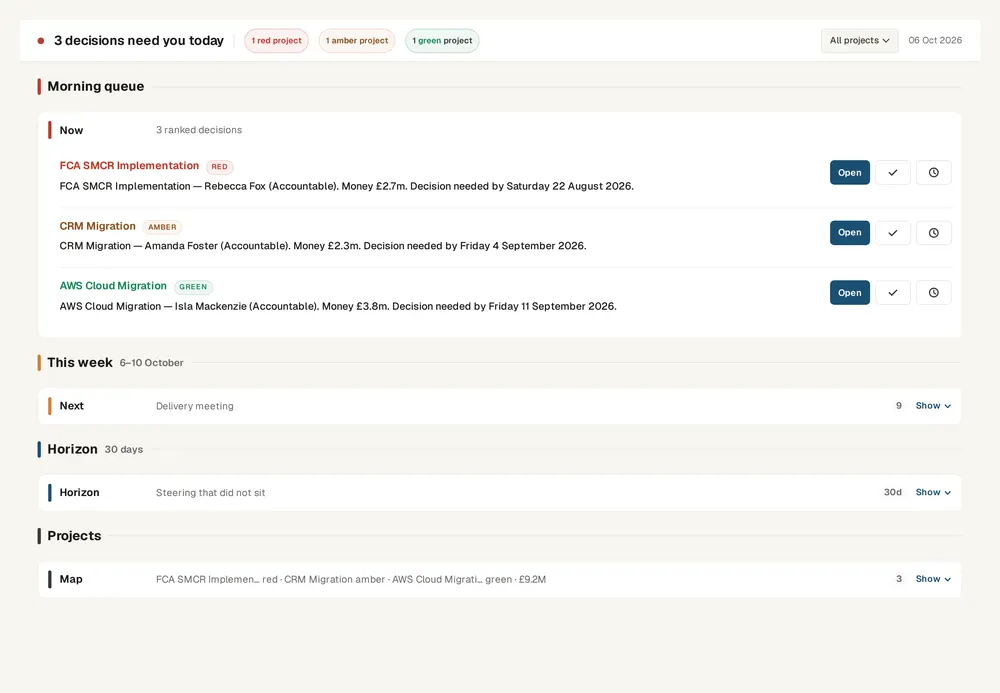
Keep this live, not in a spreadsheet
Senshin keeps your plan, RAID, budget and reports in one place, so this stays current without a weekly copy-and-paste. A 14-day trial, with sample projects.
Start your 14-day trialWhere this lives in Senshin
Or £499.90 a year. Every plan starts with a 14-day trial; after it, your work stays, read-only, until you subscribe. Cancel any time. Prices exclude tax. Enterprise is priced per contract: talk to us.
Frequently asked questions
What is the main difference between a programme and a project?
A project delivers a defined output, while a programme coordinates related projects to achieve wider outcomes and benefits.
Is a programme manager more senior than a project manager?
Often, but not always. The role is different: a programme manager manages dependencies and benefits across projects, while a project manager delivers one defined piece of work.
What is the difference between a programme and a portfolio?
A programme groups related projects around shared benefits. A portfolio groups projects and programmes for investment and prioritisation, whether or not they relate.
When do you need a programme instead of a project?
When several projects depend on each other and share a goal that no single project can deliver, so someone must manage the links and the benefits together.
More guides
Last updated: