Guides › Guide
Benefits realisation plan
Plenty of projects are delivered on time and on budget and still change nothing. A benefits realisation plan is how you find out whether the point of the project actually happened.
Outputs, outcomes and benefits
A project delivers outputs, such as a new system. Those outputs enable outcomes, such as faster order handling. The outcomes produce benefits, such as lower cost or higher revenue. A benefits realisation plan connects all three and says who is responsible for the last one.
The hard truth is that benefits usually arrive after the project team has gone home. So the plan needs an owner in the business, not just in the project.
The benefits register: columns to copy
Keep one row per benefit. Fewer, measurable benefits beat a long list of hopes.
- Benefit title and a one-sentence description.
- Type: financial (cash saved or earned) or non-financial (speed, quality, risk, satisfaction).
- Measure, or KPI, and how it will be collected.
- Baseline: the value today, before the project.
- Target: the value you expect, and the date you expect it.
- Benefit owner (a named business person) and the dependencies that must hold.
A worked example
This example uses made-up round numbers. Suppose a project replaces a manual invoice process. The benefit is lower processing effort. The baseline is 400 invoices a month at 15 minutes each, which is 100 hours. The target is 5 minutes each, which is about 33 hours, so around 67 hours a month released.
At an assumed loaded cost of 30 pounds an hour, that is about 2,000 pounds a month, or 24,000 pounds a year. If the project costs 60,000 pounds, simple payback takes two and a half years. That may be fine, or it may change the decision, and either way you now know.
- Count released hours as a benefit once someone decides how they will be used.
- Separate cashable benefits from capacity benefits in the register.
- Show assumptions beside the numbers so they can be challenged.
Tracking after go-live
Schedule benefit reviews before the project closes, typically at three, six and twelve months. Each review compares the measure with its baseline and target, and records why any gap exists.
A project may close while its benefits plan stays open, handed to the benefit owner. In Senshin the finance and benefits view keeps benefits alongside cost, so the value case is reviewed next to what the project spent.
- Review dates in the diary with named attendees.
- Report benefits in the SteerCo pack, not just delivery status.
- If a benefit slips, ask whether the cause is delivery, adoption or a wrong assumption.
- Retire benefits that are no longer valid, and say so openly.
Where it fits
Start the plan at initiation, because the business case is where benefits are promised in the beginning. Revisit it at each stage gate and again at closure. For a programme, the benefits are held at programme level, since individual projects rarely deliver them alone.
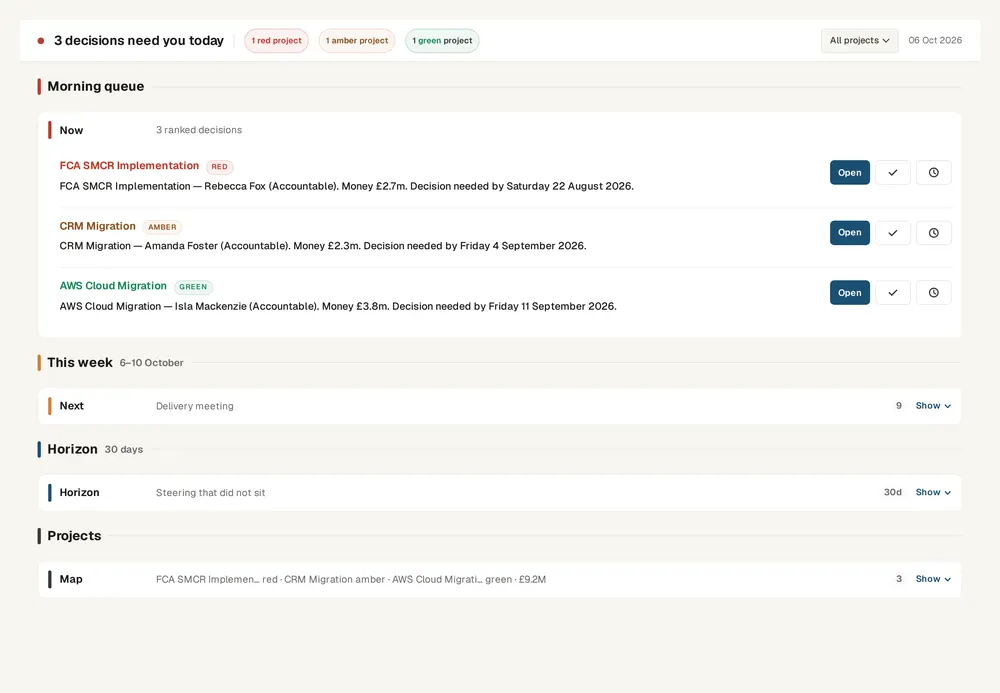
Keep this live, not in a spreadsheet
Senshin keeps your plan, RAID, budget and reports in one place, so this stays current without a weekly copy-and-paste. A 14-day trial, with sample projects.
Start your 14-day trialWhere this lives in Senshin
Or £499.90 a year. Every plan starts with a 14-day trial; after it, your work stays, read-only, until you subscribe. Cancel any time. Prices exclude tax. Enterprise is priced per contract: talk to us.
Frequently asked questions
What is a benefits realisation plan?
It is a plan that defines the benefits a project should deliver, who owns them, how they are measured and when they will be reviewed after delivery.
What is the difference between outputs, outcomes and benefits?
Outputs are what the project produces, outcomes are the changes those outputs enable, and benefits are the measurable value of those changes to the organisation.
Who is responsible for benefits realisation?
A named benefit owner in the business, usually a senior manager of the area that changes. The project manager supports but rarely owns the benefit.
How long should you track benefits after a project ends?
Until the target is met or the review period you agreed with the sponsor ends, commonly through reviews at three, six and twelve months.
More guides
Last updated: