Guides › Guide
Project closure report template
Finishing a project is not the same as closing it. A closure report is the paperwork that stops a finished project from quietly haunting you for the next six months.
What a closure report does
A project closure report tells the sponsor and the organisation what was delivered, what it cost, what is left and who owns it from here. It also gives you something to point at when somebody asks, months later, whether that thing was ever finished.
Aim for three to five pages. The sponsor signs it, so write it to be read.
Sections to copy
Use these headings in this order. Each should take a paragraph or a small table.
- Summary: the project in three sentences and the overall outcome.
- Objectives: each original objective, with delivered, partly delivered or not delivered.
- Deliverables: what was handed over, to whom and the acceptance date.
- Schedule: baseline end date, actual end date and the reasons for any gap.
- Budget: approved, final cost and variance, line by line.
- Approved changes: a list of every change request with its decision.
Open items and handover
Be honest about what is not finished. An open item with an owner is fine; one nobody mentions is a future incident.
Name the person or team that now owns running the result, and confirm they know it.
- Outstanding issues and risks, each with a new owner and date.
- Support arrangements and warranty period, where they apply.
- Documents, access and licences handed over, with their location.
- Supplier contracts: ended, extended or transferred.
- Outstanding invoices and any budget to be released or returned.
Benefits and lessons
Delivery is not the same as value. Record which benefits you expect, who will measure them and when. A closure report that forgets this makes the whole project look like a cost with no point.
Add a short list of lessons learned and point to the full log rather than repeating it.
- Expected benefits, the measure, the owner and the review date.
- Top three things that went well and top three that did not.
- Recommendations for the PMO or the next similar project.
Sign-off and wrap-up
Finish with a signature block: sponsor, project manager and the receiving service owner, each with a date. Then close the loose ends so the project really stops, releasing people, cost codes and access.
If your plan, costs and RAID log already live in one place, as they do in Senshin, much of this report is a matter of reading off figures that exist rather than reconstructing them from email.
- Archive plan, RAID log, reports and decisions where the PMO can find them.
- Release the team and close the cost codes.
- Tell stakeholders the project is closed and who to contact now.
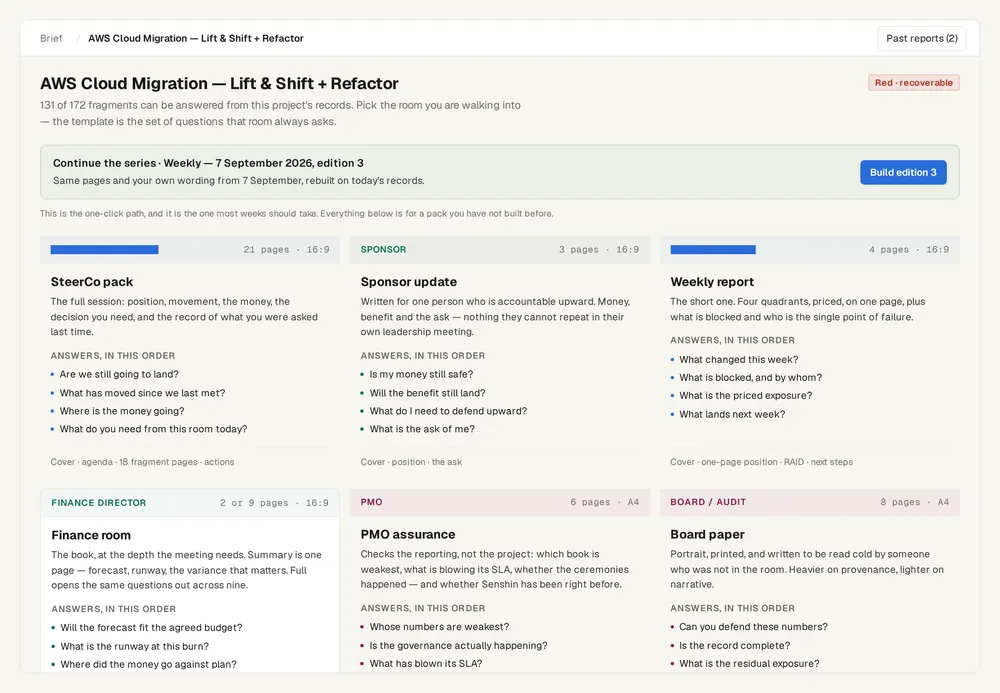
Keep this live, not in a spreadsheet
Senshin keeps your plan, RAID, budget and reports in one place, so this stays current without a weekly copy-and-paste. A 14-day trial, with sample projects.
Start your 14-day trialWhere this lives in Senshin
Or £499.90 a year. Every plan starts with a 14-day trial; after it, your work stays, read-only, until you subscribe. Cancel any time. Prices exclude tax. Enterprise is priced per contract: talk to us.
Frequently asked questions
What is a project closure report?
It is the final report of a project, recording outcomes against objectives, the final cost and schedule, open items, benefits and lessons, and confirming handover and sign-off.
What should a project closure report include?
A summary, objectives achieved, deliverables, schedule and budget against baseline, approved changes, open items, lessons learned and signatures.
Who signs off a project closure report?
Usually the project sponsor, with the project manager and the person or team who will run the result. Your governance may add others.
What is the difference between a closure report and lessons learned?
The closure report is the formal record of the outcome. Lessons learned is a detailed review of what to improve, and the closure report should point to it.
More guides
Last updated: