Guides › Guide
Project handover checklist
Handing over a project is the moment the truth falls out of the filing cabinet. Use this checklist to hand over what is real rather than what is tidy, whether you are leaving, rotating or passing a finished project to the team that will run it.
1. Agree what is being handed over
Handover goes wrong when the two sides picture different things. Write down whether this is a person handing a live project to another manager, or a delivered project passing to operations. Name the receiver, the date, and the point at which responsibility actually transfers.
- Outgoing owner, incoming owner and sponsor named.
- Effective date of transfer, not just a handover meeting date.
- Scope of the handover: whole project, one workstream or the product alone.
- Who the outgoing owner remains reachable by, and for how long.
2. Hand over the plan and the money
Pass over the current baseline and the forecast, and be honest about the gap between them. Show the next three milestones with dates and the dependencies that could move them.
Budget needs the same candour: approved, spent, committed and forecast, with anything unbilled or disputed called out.
- Approved baseline and current forecast end date.
- Critical path and next three milestones.
- Budget: approved, spent, committed, forecast.
- Open purchase orders, supplier contracts and renewal dates.
- Any approved or pending change requests.
3. Hand over the live RAID items
The RAID log is the closest thing to a memory the project has. Walk the receiver through every open risk, issue and decision, not just the red ones, and say what you were about to do next on each.
- Every open item has one named owner and a due date.
- Risks that are close to becoming issues are flagged.
- Decisions awaiting an answer, and from whom.
- Anything promised informally that is not written down.
4. Hand over the people and the politics
Introduce the receiver to sponsors, key stakeholders and suppliers in person where possible. Share the stakeholder map, but also the unwritten notes: who needs a call before a meeting, who reads everything, who reads nothing.
- Stakeholder map and communication plan.
- Governance dates: next SteerCo and its pack deadline.
- Key supplier and team contacts.
- Sensitivities the receiver should know before day one.
5. Confirm and sign off
A handover is complete when the receiver says so, not when the sender stops talking. Hold a short walkthrough, let the receiver ask the awkward questions, and record the sign-off. If you use an existing plan file, importing it into Senshin gives the receiver a live plan, RAID log and health view to start from.
- Receiver confirms they can find every document listed.
- Access to systems and folders is checked, not assumed.
- Open questions logged with owners and dates.
- Sign-off recorded by sponsor and both managers.
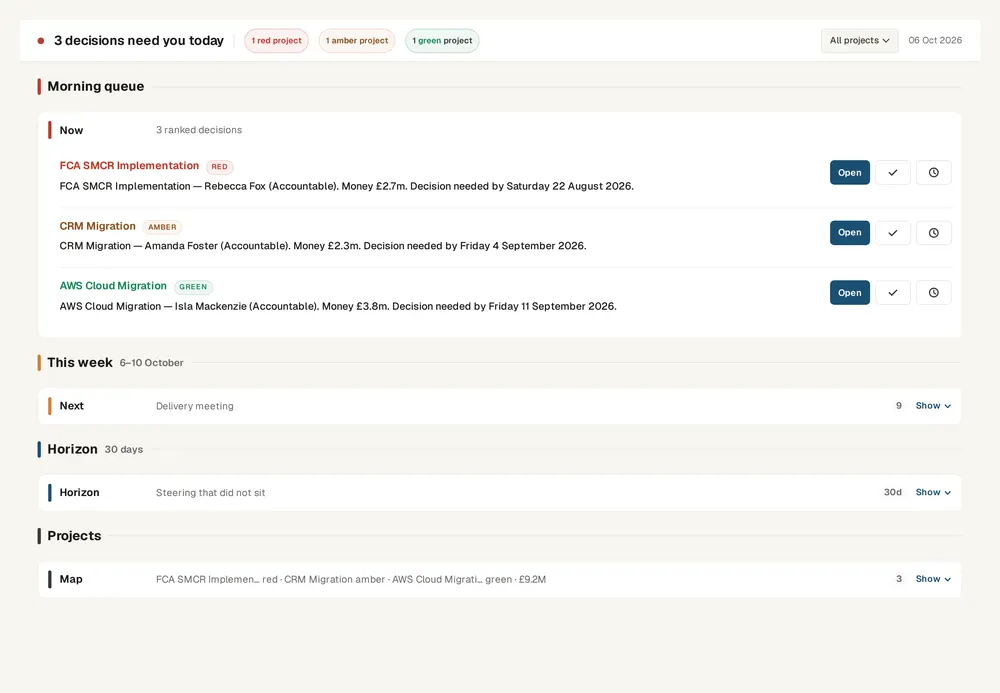
Keep this live, not in a spreadsheet
Senshin keeps your plan, RAID, budget and reports in one place, so this stays current without a weekly copy-and-paste. A 14-day trial, with sample projects.
Start your 14-day trialWhere this lives in Senshin
Or £499.90 a year. Every plan starts with a 14-day trial; after it, your work stays, read-only, until you subscribe. Cancel any time. Prices exclude tax. Enterprise is priced per contract: talk to us.
Frequently asked questions
What should be included in a project handover?
The plan and baseline, budget position, open RAID items, contracts and suppliers, stakeholder and governance details, documents and system access, and a signed confirmation from the receiver.
What is the difference between handover and closure?
Handover passes responsibility to a new owner or team. Closure formally ends the project, confirms deliverables and records lessons learned. They often happen together but are not the same.
How long should a project handover take?
Long enough for the receiver to ask every question that matters, usually a few working days of overlap for a live project. Rushed handovers are where undocumented promises go missing.
Who signs off a project handover?
The incoming owner confirms they accept it, and the sponsor or line manager normally countersigns so that responsibility is clearly recorded.
More guides
Last updated: