Guides › Guide
Earned value explained, without the textbook fog
Earned value has a reputation for being a topic you nod along to in exams and never use again. It deserves better: it is a way of asking two blunt questions, are we behind and are we over, using one consistent set of numbers. Here is the plain version.
The problem earned value solves
Spent half the budget, finished half the time: so is the project fine? You cannot tell. Spending alone says nothing about whether the work got done, and progress alone says nothing about what it cost.
Earned value puts money and progress on the same scale by measuring everything in pounds of budgeted work. That is what makes behind-schedule and over-budget separable.
- It needs a baseline: a budget spread over time against the plan.
- It needs honest progress measurement, task by task.
- It needs actual costs recorded against the same breakdown.
- It does not need special software to be useful on a small project.
The three numbers
Everything in earned value comes from three values measured at the same date. Get these right and the rest is subtraction and division.
All of them are expressed in money, which is why you can compare them directly.
- Planned value: the budget you intended to have spent on work by this date, according to the baseline.
- Earned value: the budgeted cost of the work actually completed by this date.
- Actual cost: what you have really spent on that work so far.
Reading the numbers: a worked example
Example with invented round numbers. A project has a budget of £100,000 and is four months into a ten-month plan. The baseline says £40,000 of work should be done by now, so planned value is £40,000.
The team has completed work worth £30,000 of budget, so earned value is £30,000. They have spent £36,000, so actual cost is £36,000.
- Schedule variance is earned value minus planned value: £30,000 minus £40,000 is minus £10,000. Negative means behind.
- Cost variance is earned value minus actual cost: £30,000 minus £36,000 is minus £6,000. Negative means over budget.
- Schedule performance index is earned value divided by planned value: 0.75. You have done 75p of work for every £1 planned.
- Cost performance index is earned value divided by actual cost: about 0.83. Each £1 spent has produced about 83p of planned work.
What it tells you about the future
The real power is forecasting. If cost performance continues at 0.83, a £100,000 project will finish near £120,000. That is a conversation to have now, not in month nine.
The forecast is as good as the assumption behind it, so state it: is the overspend a one-off, or will it continue?
- Typical trend assumption: future work costs the same ratio as work so far.
- One-off assumption: the overspend was a single event and the remaining budget is still valid.
- Show both forecasts to the sponsor when you are unsure, and say which you believe.
Where earned value goes wrong
Earned value is not hard, but it is easy to feed it rubbish. Weak progress measurement is the most common cause.
If everything is reported as ninety per cent complete for six weeks, the numbers will look healthy and tell you nothing.
- Use clear completion rules, such as 0% until started, 50% once built, 100% once accepted.
- Keep work packages small enough to finish within a reporting period.
- Record actual costs promptly, including contractor time not yet invoiced.
- In Senshin, finance and benefits sit alongside the plan, so budget, progress and forecast can be read together.
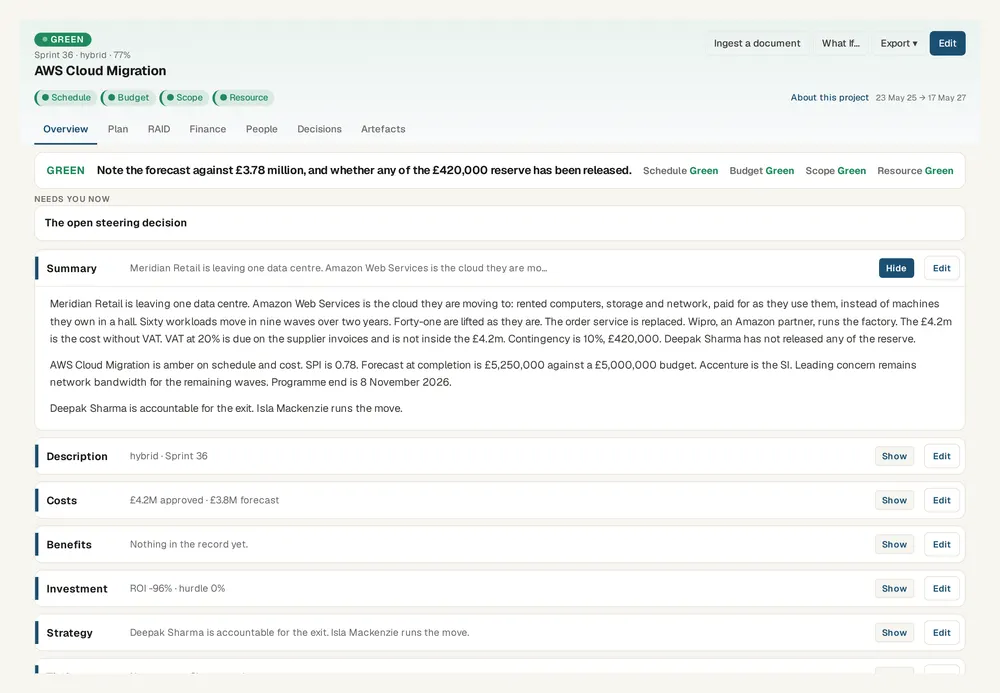
Keep this live, not in a spreadsheet
Senshin keeps your plan, RAID, budget and reports in one place, so this stays current without a weekly copy-and-paste. A 14-day trial, with sample projects.
Start your 14-day trialWhere this lives in Senshin
Or £499.90 a year. Every plan starts with a 14-day trial; after it, your work stays, read-only, until you subscribe. Cancel any time. Prices exclude tax. Enterprise is priced per contract: talk to us.
Frequently asked questions
What is earned value in simple terms?
Earned value is the budgeted cost of the work you have actually completed. Compared with what you planned to complete and what you spent, it shows whether a project is behind or over budget.
What is the difference between planned value and earned value?
Planned value is the work you intended to have done by a date. Earned value is the work you have really done by that date, both measured in budgeted pounds.
Is earned value just for large projects?
No. The method scales down well, as long as you have a baseline and a sensible way to measure completion. A spreadsheet is enough to start.
What does a negative variance mean?
A negative schedule variance means less work done than planned. A negative cost variance means the completed work has cost more than it was budgeted to cost.
More guides
Last updated: