Guides › Guide
Project baseline explained
A baseline is the plan you promised, frozen so you can see how far reality has wandered from it. Without one, every project is on schedule, because the schedule keeps moving.
What a baseline is
A project baseline is the approved version of the scope, schedule and cost that you measure progress against. Once approved, it does not change just because the project does; it changes through a controlled decision alone.
Think of it as the line on the wall where you marked your child's height. You can always see how much has grown.
- Scope baseline: what is being delivered and what is excluded.
- Schedule baseline: approved start and finish dates for tasks and milestones.
- Cost baseline: the approved budget, phased over time.
- Often also resources and key assumptions.
What to capture
Capture enough to compare later, not so much that nobody reads it. A baseline is useful when you can set the current forecast beside it.
- Task start and finish dates, and the key milestones.
- Planned effort or cost for each task or work package.
- Total approved budget and any contingency held.
- The date it was approved, and by whom.
- The version number, so you always know which baseline is meant.
A worked example
Here is a made-up example. Say a project baseline says go-live on 30 June and a budget of £200,000. By month three the forecast says go-live on 28 July and spend of £215,000.
Variance is simply forecast minus baseline: four weeks late and £15,000 over. That is a fact to report, not a failure to hide, and the baseline is what makes it visible.
- Schedule variance: 4 weeks late (illustrative numbers).
- Cost variance: £15,000 over budget (illustrative numbers).
- Without the baseline, the same project would just look like it was moving to a new date.
When to re-baseline
Re-baseline when the original plan is no longer a fair yardstick, and not a day sooner. Doing it every time a task slips defeats the point.
- After an approved change to scope, time or cost.
- After a formal recovery plan is agreed with the steering committee.
- Never silently; always record the decision and keep the old version.
- Keep the original baseline so you can still show total drift.
Keeping baselines in view
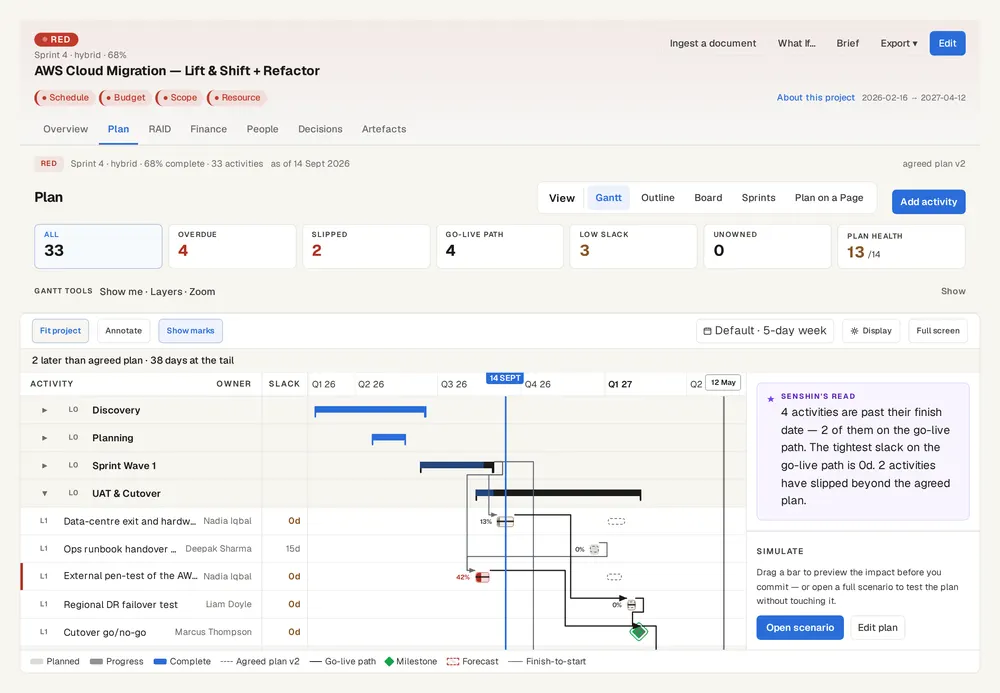
Senshin plans can be compared against the approved dates on the Gantt, so variance is visible to the whole team rather than buried in a spreadsheet.
Keep this live, not in a spreadsheet
Senshin keeps your plan, RAID, budget and reports in one place, so this stays current without a weekly copy-and-paste. A 14-day trial, with sample projects.
Start your 14-day trialWhere this lives in Senshin
Or £499.90 a year. Every plan starts with a 14-day trial; after it, your work stays, read-only, until you subscribe. Cancel any time. Prices exclude tax. Enterprise is priced per contract: talk to us.
Frequently asked questions
What is a project baseline?
A project baseline is the approved scope, schedule and cost that you measure actual progress against throughout the project.
What is the difference between a baseline and a forecast?
The baseline is what was approved. The forecast is your current best estimate of where the project will end up.
How often should you re-baseline a project?
Rarely, and just after an approved change or formal recovery plan. Frequent re-baselining hides real drift.
Can you have more than one baseline?
Yes. Keep the original and each approved revision, numbered, so you can show both recent variance and total drift.
More guides
Last updated: