Guides › Guide
Earned value formulas with a worked example you can copy
You know what earned value is. Now you need the earned value formulas on one page, with real numbers, so you can copy them into a spreadsheet and stop re-deriving them in the car park before SteerCo. Cheat sheet follows.
The inputs
Every formula below needs the same four starting figures, all measured at the same status date. This example is invented for illustration: it is not customer data.
Project: budget at completion of £200,000, planned over twelve months. Status date: end of month six.
- Budget at completion: £200,000 (the total approved budget).
- Planned value: £100,000 (half the work was scheduled by month six).
- Earned value: £85,000 (the budgeted value of work actually finished).
- Actual cost: £95,000 (the money genuinely spent so far).
Variances: how far off are we in pounds?
Variances subtract one figure from another, so the answer is in money. Negative is bad on both.
Use them for narrative: we are £15,000 behind and £10,000 over.
- Schedule variance = earned value minus planned value = £85,000 minus £100,000 = minus £15,000.
- Cost variance = earned value minus actual cost = £85,000 minus £95,000 = minus £10,000.
Indices: how efficient are we?
Indices divide, so the answer is a ratio. One means exactly on plan, below one means worse than plan.
They are the numbers to trend week by week, because a ratio is comparable across projects of any size.
- Schedule performance index = earned value divided by planned value = 85,000 / 100,000 = 0.85.
- Cost performance index = earned value divided by actual cost = 85,000 / 95,000 = about 0.89.
- Reading: for each £1 of work planned we delivered 85p, and each £1 spent bought about 89p of planned work.
Forecasts: where will we land?
There is more than one forecast formula, because it depends on what you believe about the remaining work. Pick one, state it, and be ready to defend it.
Forecast at completion is the estimate of the final cost. Estimate to complete is the money still to spend.
- If current efficiency continues: forecast at completion = budget at completion divided by cost performance index = 200,000 / 0.89 = about £224,000.
- If the overspend was a one-off: forecast at completion = actual cost + (budget at completion minus earned value) = 95,000 + 115,000 = £210,000.
- Estimate to complete = forecast at completion minus actual cost. On the trend forecast: about £129,000.
- Variance at completion = budget at completion minus forecast at completion = about minus £24,000 on the trend forecast.
To-complete performance index: is recovery realistic?
This is the sanity check that sponsors like. It asks how efficient the team must be for the rest of the work to land on the original budget.
Formula: (budget at completion minus earned value) divided by (budget at completion minus actual cost).
- Here: (200,000 minus 85,000) / (200,000 minus 95,000) = 115,000 / 105,000 = about 1.10.
- The team would need to be about 10% more efficient than planned for every remaining month. Ask whether anything in the plan supports that.
- If the figure is much above one, say so plainly and bring options to SteerCo rather than hoping.
- In Senshin the finance and weekly reports sit next to the plan, so the same status date feeds both.
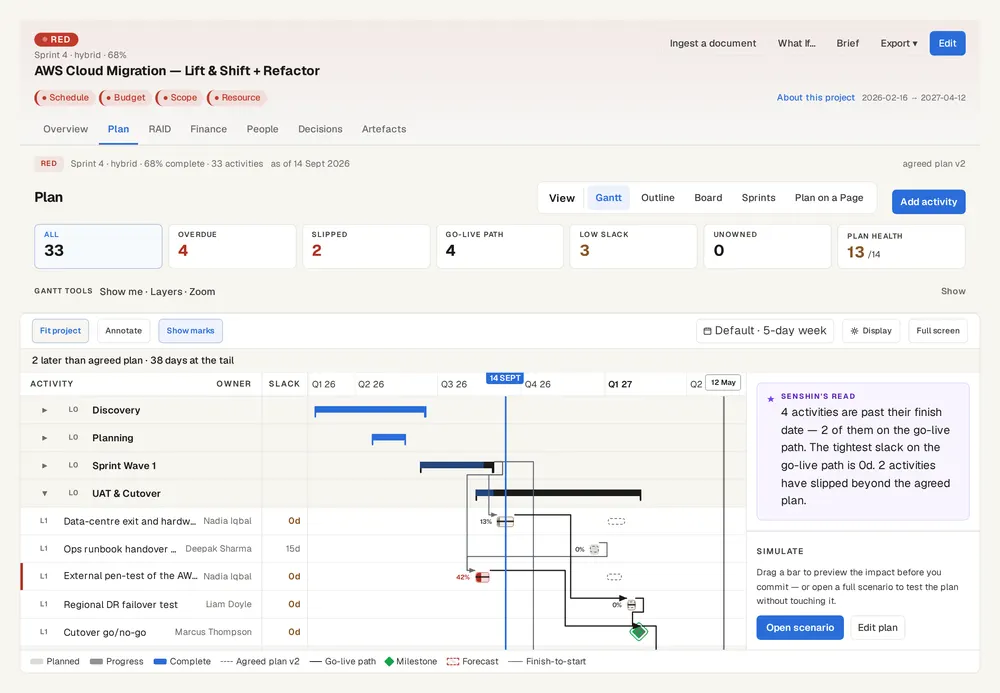
Keep this live, not in a spreadsheet
Senshin keeps your plan, RAID, budget and reports in one place, so this stays current without a weekly copy-and-paste. A 14-day trial, with sample projects.
Start your 14-day trialWhere this lives in Senshin
Or £499.90 a year. Every plan starts with a 14-day trial; after it, your work stays, read-only, until you subscribe. Cancel any time. Prices exclude tax. Enterprise is priced per contract: talk to us.
Frequently asked questions
What are the main earned value formulas?
Schedule variance is earned value minus planned value, cost variance is earned value minus actual cost, and the two performance indices divide earned value by planned value and by actual cost respectively.
How do I calculate forecast at completion?
The usual version divides the original budget by the cost performance index. If you believe the overspend was a one-off, add actual cost to the remaining budgeted work instead.
What is a good cost performance index?
One or above means you are delivering at least as much value as you spend. Below one means each pound is buying less than planned. Trend it over several weeks rather than judging a single reading.
Can I do earned value in a spreadsheet?
Yes. Four columns (budget, planned value, earned value, actual cost) and the formulas above are enough for most projects.
More guides
Last updated: