Guides › Guide
Project charter template
A project charter is the document you wish existed the day the sponsor says, Oh, I thought it would also do that. Keep it to two pages and make every line something someone can be held to.
What a charter is for
A charter gives the project manager authority and gives the sponsor a record of what they agreed to. It is shorter than a business case and less detailed than a plan. Its job is to answer the questions that otherwise get asked, loudly, in month four.
Write it with the sponsor, not for them. A charter that arrives fully formed and unread is just a document with a signature box.
Headings to copy
Paste these into a blank page and fill each with a few lines, not a few paragraphs.
- Project name, sponsor, project manager and date of version.
- Purpose: the problem or opportunity, in two sentences a stranger would understand.
- Objectives and success measures: how you will know it worked, with a number and a date where possible.
- Scope: what is in, what is out, and what is deferred.
- Deliverables and key milestones, with target dates.
- Budget and funding source, with the contingency stated separately.
- Governance: who sits on the steering committee, who decides what, and how often you report.
- Assumptions, constraints and dependencies.
- Top risks at the point of approval.
- Authority and tolerances: what the project manager can decide alone and when to escalate.
Making the scope section earn its keep
Scope is where most arguments start, so be blunt. An explicit out-of-scope list is more useful than a long in-scope one, because it names the things people will otherwise assume.
If something is genuinely undecided, say so and name who will decide it and by when.
- In scope: the deliverables and the business areas affected.
- Out of scope: the adjacent things people may expect, written plainly.
- Deferred: valuable but not now, with a note on when to revisit.
- Change route: how a new request gets assessed and approved.
Tolerances and authority
A charter that says the project manager is in charge, without saying how far, is an invitation to be overruled. State the tolerances for time, cost and scope in plain figures and say what happens when you breach them.
- Schedule: for example, up to two weeks of slip handled by the project manager.
- Cost: an agreed amount or percentage of the budget, then escalate.
- Scope: no change to a deliverable without an approved change request.
- Escalation: who you go to, and how fast they have agreed to respond.
After sign-off
Treat the charter as the anchor for the baseline, the stakeholder map and the governance rhythm. In Senshin the project overview, plan and governance setup sit together, so the charter content has an obvious home once approved.
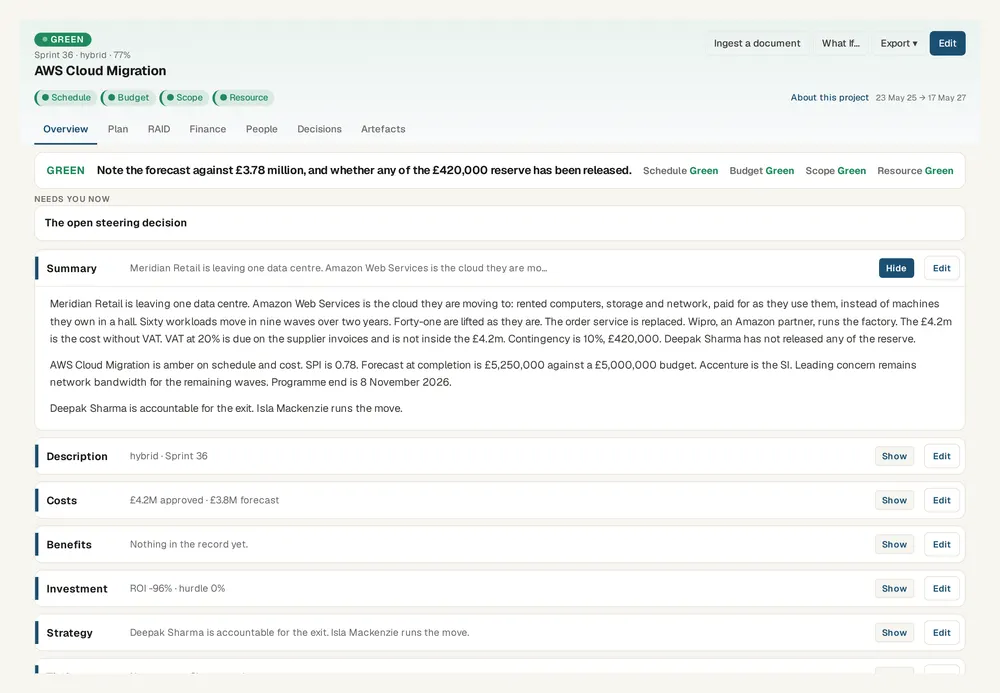
Keep this live, not in a spreadsheet
Senshin keeps your plan, RAID, budget and reports in one place, so this stays current without a weekly copy-and-paste. A 14-day trial, with sample projects.
Start your 14-day trialWhere this lives in Senshin
Or £499.90 a year. Every plan starts with a 14-day trial; after it, your work stays, read-only, until you subscribe. Cancel any time. Prices exclude tax. Enterprise is priced per contract: talk to us.
Frequently asked questions
What is a project charter?
A project charter is a short document, approved by the sponsor, that states why the project exists, what it will deliver, the budget and timeline, who governs it and what authority the project manager has.
What is the difference between a project charter and a project plan?
The charter authorises the project and sets the boundaries. The plan describes in detail how the work will be done, by whom and when.
How long should a project charter be?
Two pages is a good target. If it runs longer, you are probably writing the plan or the business case inside it.
Who signs the project charter?
The sponsor signs, and usually any other senior stakeholders whose budget or people the project depends on. The project manager signs to confirm they accept the mandate.
More guides
Last updated: