Guides › Guide
Project kickoff meeting checklist
A kickoff meeting is the one hour where everyone is in the room, listening and still smiling. Waste it on slides about company history and you will spend the next six months re-explaining the basics by email.
Before the meeting: get your ducks in a row
Send the invite at least a week ahead with the agenda attached, so nobody can claim surprise. Then check that the sponsor has actually agreed to open the meeting; a kickoff without the sponsor is just a meeting.
Do the groundwork that makes the hour useful rather than exploratory.
- Draft the project charter or one-page brief and circulate it beforehand.
- Confirm the attendee list against your stakeholder map, not against who happens to be available.
- Prepare a draft-one plan or milestone view, clearly marked draft.
- Book a room or call long enough for questions, plus ten minutes of slack.
- Appoint a note-taker so you can run the meeting.
Open with the why
People work harder on a project they understand. Let the sponsor explain the business reason in their own words, then restate it in one sentence you will reuse all project long.
- Problem or opportunity being addressed, in plain language.
- Measurable objectives and what success looks like at the end.
- What is in scope, what is out, and what is still undecided.
- Constraints you already know: budget, deadline, regulation, shared resources.
Walk through the how
Now show the shape of the work. Keep it high level; this is a map, not a turn-by-turn route.
- Major phases and milestones with target dates.
- Governance: who sits on the steering committee and how often it meets.
- Roles and responsibilities, ideally as a draft RACI matrix.
- How you will report: format, day of the week and audience.
- Ways of working: where documents live, how changes are requested.
Surface risks and dependencies early
Kickoff is when people are most willing to say what worries them. Ask directly, then write it down while they are still talking.
- Capture the top risks and assumptions as live RAID log entries.
- Name the dependencies on other teams or suppliers, with a contact for each.
- Ask each attendee: what would make this fail?
- Agree who owns each risk before the meeting ends.
Close with decisions and actions
End on commitments, not applause. Read the actions back aloud so there is no dispute later about who said they would do what.
- Every action has one named owner and a date.
- Confirm the date of the next meeting and the next report.
- Send the notes within 24 hours, with actions at the top.
- Log any decisions taken, with who made them and why.
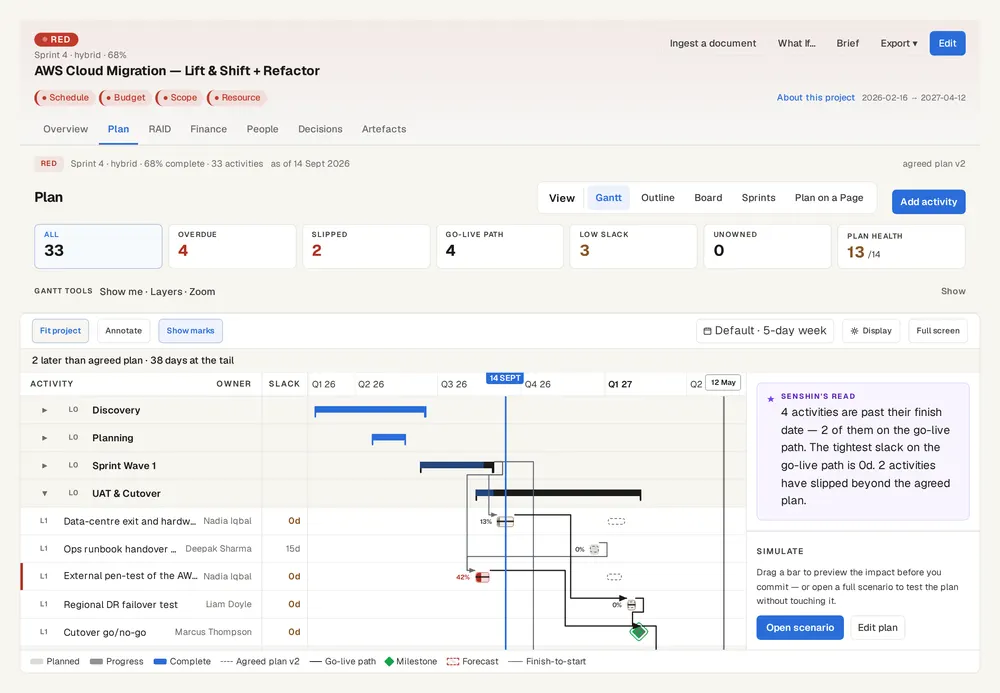
Keep this live, not in a spreadsheet
Senshin keeps your plan, RAID, budget and reports in one place, so this stays current without a weekly copy-and-paste. A 14-day trial, with sample projects.
Start your 14-day trialWhere this lives in Senshin
Or £499.90 a year. Every plan starts with a 14-day trial; after it, your work stays, read-only, until you subscribe. Cancel any time. Prices exclude tax. Enterprise is priced per contract: talk to us.
Frequently asked questions
What should be in a project kickoff meeting?
A kickoff covers the purpose and objectives, scope boundaries, high-level plan and milestones, roles, governance, ways of working, early risks and clear next actions with owners.
Who should attend a project kickoff meeting?
The sponsor, the project team, key stakeholders and anyone who owns a dependency. Keep the core list tight and send the notes to everyone else.
How long should a kickoff meeting be?
Between 60 and 90 minutes suits most projects. Larger programmes often run a longer session, or split it into a kickoff and team workshops.
What is the difference between a kickoff meeting and a planning workshop?
The kickoff aligns everyone on purpose, scope and roles. A planning workshop goes deeper into tasks, estimates and dependencies, and usually follows it.
More guides
Last updated: