Guides › Guide
Stakeholder map template: who matters, and how to handle them
Every project has someone who was never invited to the kickoff and will have an opinion at go-live. A stakeholder map finds them early, while they are still friendly. Here is a template you can fill in over one coffee.
1. List everyone who can help or hurt the project
Start with a messy brain dump: sponsors, users, suppliers, regulators, finance, IT, the person whose team loses a desk. Aim for completeness before polish.
Ask your sponsor and two team members to add names. Everyone you miss will turn up later, with feelings.
- Include people affected by the change, not just those running it.
- Add groups as well as individuals, such as the service desk or the works council.
- Note anyone who can block approval, budget or access.
- Record each person's role and reporting line.
2. Score power and interest
Give each stakeholder a rating for power (their ability to influence the outcome) and interest (how much they care or are affected). High, medium or low is enough.
Plot them on a two-by-two grid. The position tells you the default approach.
- High power, high interest: manage closely. Involve in decisions and brief often.
- High power, low interest: keep satisfied. Short, relevant updates, no surprises.
- Low power, high interest: keep informed. Regular news and a route for questions.
- Low power, low interest: monitor. Check occasionally that nothing has changed.
3. Record the stance and what they need
Power and interest tell you how much attention to give. Stance tells you what to do with it. Be honest, but keep the sheet private.
Write what each person wants from the project, and what they fear. Fear is usually where the objection is hiding.
- Current stance: champion, supportive, neutral, sceptical or opposed.
- Desired stance: where you need them to be by the next stage gate.
- Needs and concerns, in their words where possible.
- Influence on others: who listens to them?
4. Copyable column set and engagement plan
Use this structure as a table in a spreadsheet or document, one row per stakeholder.
Each row ends with an action that has an owner and a date, otherwise the map is decoration.
- Name and role.
- Power (H/M/L) and interest (H/M/L).
- Current stance and desired stance.
- Key concern or need.
- Engagement approach: how, how often, and who owns the relationship.
- Next action and due date.
5. Review it on a schedule
A stakeholder map goes stale quickly: reorganisations, new sponsors, quieter people becoming louder. Put a review in the diary rather than relying on memory.
In Senshin the stakeholders and governance area holds the people involved in a project and who sits on which board, so the map can sit next to the plan it supports.
- Review at every stage gate and after any reorganisation.
- Move people between quadrants when their situation changes.
- Feed engagement actions into your RAID log or weekly plan.
- Share a simplified version with the sponsor, not the candid one.
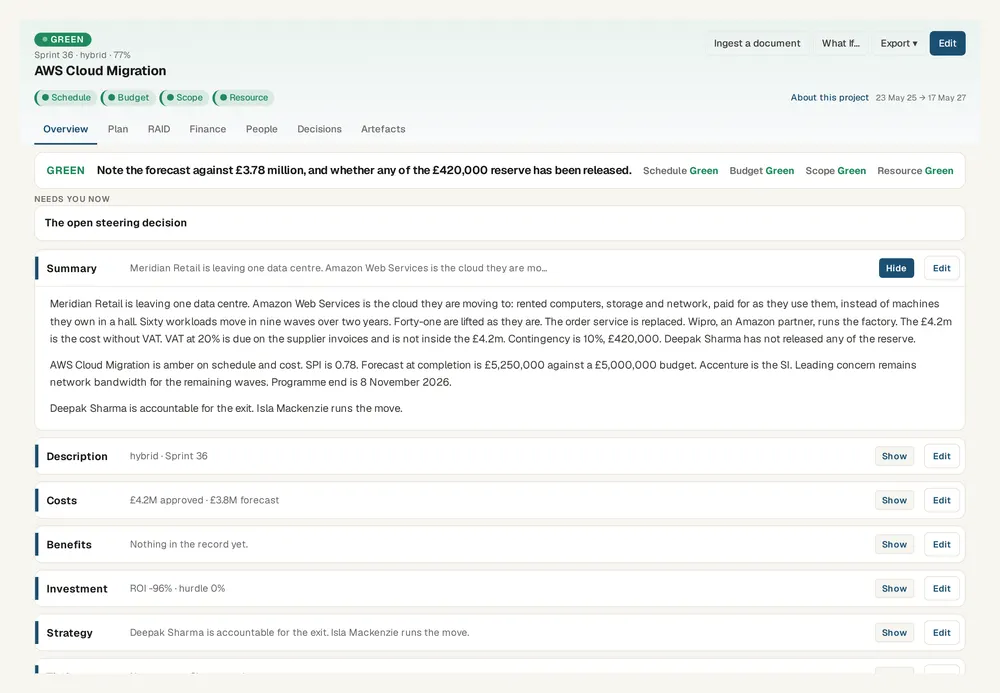
Keep this live, not in a spreadsheet
Senshin keeps your plan, RAID, budget and reports in one place, so this stays current without a weekly copy-and-paste. A 14-day trial, with sample projects.
Start your 14-day trialWhere this lives in Senshin
Or £499.90 a year. Every plan starts with a 14-day trial; after it, your work stays, read-only, until you subscribe. Cancel any time. Prices exclude tax. Enterprise is priced per contract: talk to us.
Frequently asked questions
What is a stakeholder map?
A stakeholder map is a one-page view of everyone with an interest in a project, showing how much power and interest each has and how you plan to engage them.
What is the power and interest grid?
It is a two-by-two chart that places stakeholders by their influence over the project and how much they care about it, which suggests whether to manage them closely, keep them satisfied, keep them informed or monitor them.
How is a stakeholder map different from a RACI matrix?
A stakeholder map covers how to engage people with a stake in the project. A RACI matrix assigns roles for specific deliverables and decisions. They work well together.
Should I share my stakeholder map?
Share a clean version with your sponsor and team. Keep notes on stance and concerns private, since candid comments can do harm if circulated.
More guides
Last updated: