Guides › Guide
Scope creep: how to manage it
Scope creep never arrives with a fanfare. It turns up as a small favour, a quick tweak or a harmless 'while you're in there', and by month four the project is twice the size and nobody remembers agreeing to it.
What scope creep actually is
Scope creep is growth in the work that happens without a matching change to time, budget or resources. Growth with a decision attached is just change; growth without one is creep.
The distinction matters because you are not trying to stop change. You are trying to make sure someone with authority chose it.
- Small additions accepted informally and never recorded.
- Requirements that become more detailed as understanding grows.
- Stakeholders adding wishes after sign-off.
- Gold plating: the team doing more than was asked.
Why it happens
Rarely through bad intent. Usually the original scope was vague, nobody owned it, or saying yes felt cheaper than the conversation required to say no.
- Scope written as outcomes with no boundaries.
- No agreed route for requesting changes.
- New stakeholders joining mid-project.
- Sponsors who say yes in the corridor.
Spot it early
The earliest signal is rarely in the plan. It is in the conversations, and in the gap between what is delivered and what the baseline says should exist.
- Tasks appearing in the plan that map to no requirement.
- Effort rising while milestones stay put.
- The phrase 'it is just a small thing' in meetings.
- Deliverables described differently by different people.
Run a simple change control routine
Keep it light enough that people use it. A heavy process just moves the creep underground.
- Write the request down with who asked and why.
- Assess the impact on time, cost, risk and quality.
- Take it to the person with authority: sponsor or steering committee.
- Record the decision, and update the baseline if approved.
- Log rejected and deferred requests so they are not asked again every month.
Keep the evidence
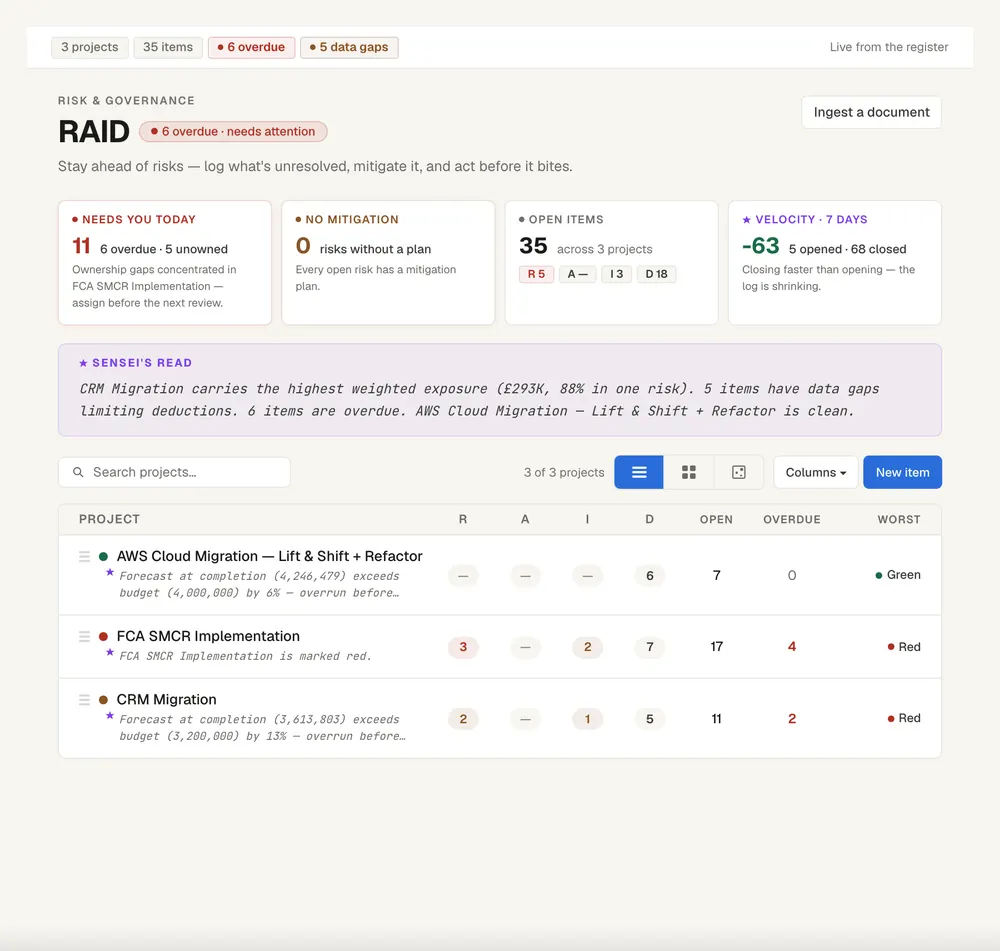
The best defence in a difficult conversation is a record. In Senshin, decisions sit in the RAID log linked to the plan tasks they change, so you can show exactly what was added, when and who approved it.
Keep this live, not in a spreadsheet
Senshin keeps your plan, RAID, budget and reports in one place, so this stays current without a weekly copy-and-paste. A 14-day trial, with sample projects.
Start your 14-day trialWhere this lives in Senshin
Or £499.90 a year. Every plan starts with a 14-day trial; after it, your work stays, read-only, until you subscribe. Cancel any time. Prices exclude tax. Enterprise is priced per contract: talk to us.
Frequently asked questions
What is scope creep in project management?
Scope creep is the gradual growth of project work beyond what was agreed, without a matching decision on time, budget or resources.
How do you prevent scope creep?
Define scope boundaries clearly, agree a change control route at the start, and make every addition a recorded decision by someone with authority.
Is all scope change bad?
No. Changes that deliver real value and are approved with their cost understood are good project management. The problem is unmanaged change.
What is the difference between scope creep and gold plating?
Scope creep is extra work requested or accepted from outside the team. Gold plating is the team adding extras nobody asked for.
More guides
Last updated: