Guides › Guide
Critical path method explained
Every plan has a handful of tasks where a single day of delay moves the end date, and a long tail where it does not. The critical path method tells you which is which, before the sponsor does.
Step 1: List the tasks, durations and dependencies
The critical path method needs three things for every task: how long it takes, and which tasks must finish before it can start. Everything else follows from those.
Here is a small example with made-up numbers, as an illustration. Task A takes 3 days. Task B takes 4 days and follows A. Task C takes 2 days and follows A. Task D takes 3 days and needs both B and C to finish.
- Use working days and take out bank holidays and known leave.
- Record real dependencies, not preferences about order.
- Add a single start and a single finish so every path joins up.
Step 2: Trace every path
A path is a chain of tasks from start to finish. In the example there are two: A, B, D, and A, C, D.
Add up the durations on each. A plus B plus D is 3 + 4 + 3 = 10 days. A plus C plus D is 3 + 2 + 3 = 8 days. The longest path is the critical path, so the project takes 10 days.
- Critical path: A, B, D at 10 days.
- Non-critical path: A, C, D at 8 days.
- Any delay to A, B or D moves the finish date day for day.
Step 3: Forward and backward pass
The forward pass finds the earliest each task can start and finish. A runs from day 0 to day 3. B runs 3 to 7 and C runs 3 to 5. D cannot start until both B and C are done, so it starts at day 7 and finishes at day 10.
The backward pass works from the finish date to find the latest each task can finish without delaying the project. D must finish by day 10 and start by day 7. That means C must finish by day 7, even though it could finish at day 5.
- Earliest start and earliest finish come from the forward pass.
- Latest start and latest finish come from the backward pass.
- Where the earliest and latest dates are equal, the task is critical.
Step 4: Read the slack
Slack (also called float) is how long a task can slip without moving the end date. Subtract the earliest finish from the latest finish. For C that is 7 - 5 = 2 days. A, B and D have zero.
Zero slack is the signal. Those tasks get your attention, your best people and your earliest warning.
- Zero slack: critical, protect it.
- Some slack: monitor, but you can use it to level resources.
- Negative slack: you are already late against a fixed date.
Step 5: Use it, then keep it current
The critical path moves. If C overruns by three days, it becomes the longest path and the project finishes on day 11. Recheck after every material change.
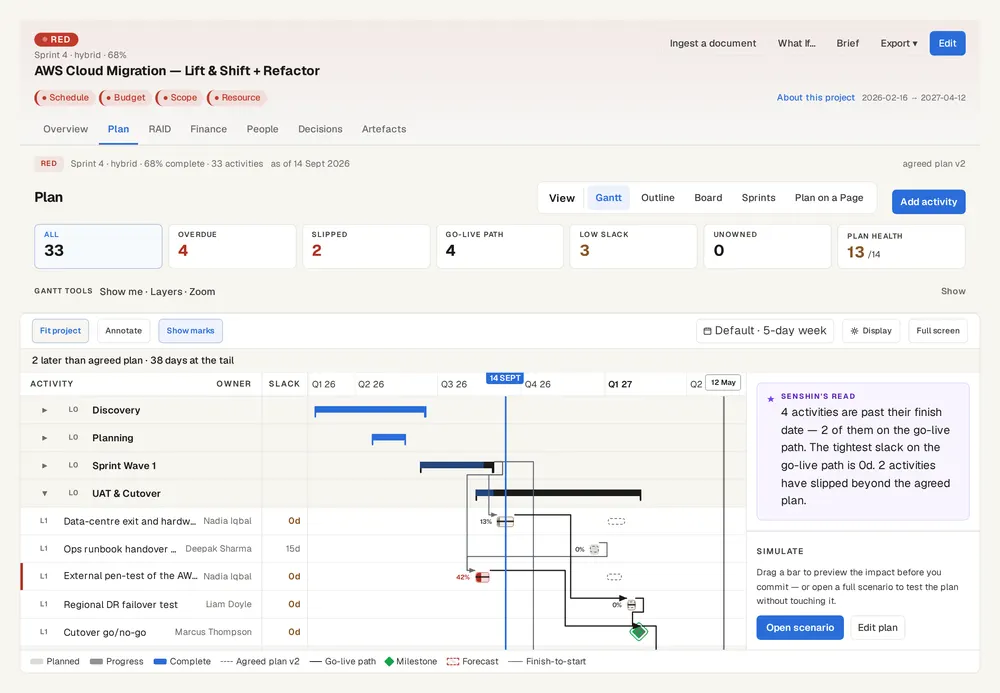
In Senshin the plan highlights the critical path on the Gantt chart, and what-if simulations let you test the effect of a slipped task before you tell the sponsor.
- Recalculate whenever a duration or dependency changes.
- Report the critical tasks, not the whole plan, to the steering committee.
- Shorten the path by overlapping tasks or adding capacity, and check the cost.
Keep this live, not in a spreadsheet
Senshin keeps your plan, RAID, budget and reports in one place, so this stays current without a weekly copy-and-paste. A 14-day trial, with sample projects.
Start your 14-day trialWhere this lives in Senshin
Or £499.90 a year. Every plan starts with a 14-day trial; after it, your work stays, read-only, until you subscribe. Cancel any time. Prices exclude tax. Enterprise is priced per contract: talk to us.
Frequently asked questions
What is the critical path method?
It is a way of finding the longest chain of dependent tasks in a project. That chain sets the shortest possible duration, so any delay to a task on it delays the finish.
What is slack in project management?
Slack, or float, is the amount of time a task can be delayed without delaying the project end date. Tasks on the critical path have none.
Can a project have more than one critical path?
Yes. If two chains of tasks have the same total duration, both are critical, and the project carries more risk because there are more places for a delay to bite.
Does the critical path change during a project?
Often. As tasks finish early or late, a different chain can become the longest, so recalculate regularly.
More guides
Last updated: